
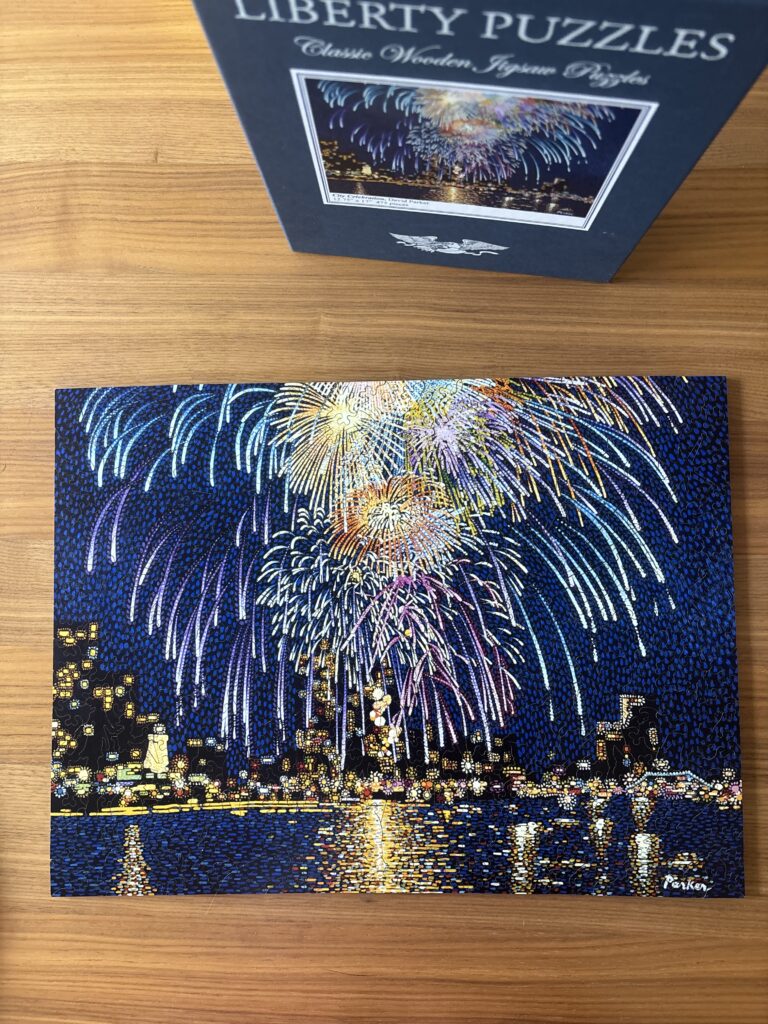
I was a few pieces short of finishing a 4th of July Liberty puzzle when I gave up looking and went to make dinner. An hour later, standing at the stove, I saw exactly where those pieces were supposed to go. It wasn’t because I was thinking about the puzzle, but something else caught my attention and the missing piece showed up attached to it.
Writer Pam Houston calls these moments “glimmers.” A flash of sensory detail, an odd juxtaposition, a stray comment that lands wrong and then lands right. She collects them the way other people collect rocks or matchbooks, small and specific and seemingly unrelated to whatever she’s working on, until one shows up and slots into the story she’s been stuck on for weeks.
I’ve lost count of how many times this has happened in my own writing. A half-finished chapter sits untouched for a month. Then a conversation with a Vistage member, a line in a book I’m reading for something else entirely, a moment while I’m out walking Rosie, and the chapter isn’t stuck anymore. The connective tissue was missing and now it’s there.
The Myth & Reality of the Muse
This is the pairing most of us expect when we talk about inspiration. Creativity is where inspiration is supposed to live. Painters wait for it, writers chase it, and we’ve built an entire mythology around the muse showing up at 2 a.m. with exactly the right idea. The pairing holds up because it’s true. Inspiration genuinely is how a lot of creative work gets unstuck.
The challenge with this myth is that it implies passivity. You’re minding your own business and lightning finds you. What actually happens is closer to this: you were already working the problem. The puzzle pieces didn’t show up because I stopped thinking about the puzzle. They showed up because I’d spent an hour handling every piece in that box, turning them over, checking them against the picture on the front, building a kind of familiarity with the shape of what was missing. By the time I wasn’t looking anymore, I already knew exactly what I needed. My brain just needed a break from the direct search to notice it.
Writers talk about this constantly without naming it. You sit with a manuscript long enough that you stop seeing individual scenes and start seeing the shape of what’s absent. That’s not mystical (though I will make an argument for a tiny bit of mysticism – if you haven’t read Big Magic by Elizabeth Gilbert, you should.). That’s pattern recognition built through hours of unglamorous contact with the material. The glimmer still has to show up, but it shows up to a mind that’s primed to recognize it, not a mind that’s simply open and waiting.
Creativity Belongs to Everyone
This matters for anyone who leads or builds or makes things, not only for people with manuscripts. The leaders I work with who describe themselves as “not creative” are almost never short on inspiration. They’re short on the hours of direct contact with their own problem that would let them recognize a glimmer if one landed in their lap. Inspiration didn’t skip them. They weren’t primed to catch it.
I’ve watched this play out in Vistage rooms more times than I can count. A member will describe a business problem they’ve been circling for months, and somewhere in the middle of someone else’s update, a phrase or an example lands and you can see the shift happen on their face. It looks like a lucky accident from the outside. In reality, it’s the payoff of months spent turning the problem over, showing up to the same table, staying close enough to the work that a stray idea from an unrelated conversation had somewhere to land.
Detachment, Not Disconnection
So the practical version of this isn’t to wait for inspiration and it isn’t to force creativity through sheer will either. It’s to stay in contact with the thing you’re stuck on, even when the contact isn’t producing anything, so that when the missing piece shows up somewhere unrelated, you’re equipped to recognize it as yours.
I’d add one more thing, because it’s the part that took me the longest to learn. Not every glimmer arrives on schedule. Some Liberty puzzles stay a few pieces short for a long time. Please don’t take that as evidence that the process failed. It’s evidence you’re still in the part of the work that doesn’t feel like progress, which is where most of the real building happens anyway.
If you’re in that stretch right now, sitting with a project that refuses to resolve, the instruction isn’t to give up and hope for a bolt of lightning. Keep handling the pieces. Keep circling the problem, even unglamorously, even without a breakthrough in sight. The glimmer is likely already somewhere nearby. Your job is just to stay familiar enough with what you’re missing that you recognize it when it shows
So keep the pieces out. Keep turning them over even on the days it feels pointless. You won’t know which ordinary moment is carrying your missing piece until it’s already in your hand.