
Have you ever stepped into a cathedral like Notre Dame or Saint Peter’s Basilica and felt your whole body exhale? The ceilings soar, light spills in from every direction, and for a moment the noise of the world falls away. You feel a sense of elevation, a little more in awe, a little more open.
H. G. Wells once wrote that a great cathedral “inspires awe by its size, beauty and age” and sets the soul “trembling with wonder and gratitude.” That, to me, is what mental spaciousness feels like.
Designing for spaciousness is about shaping our environments, both physical and mental, so they naturally encourage clarity, creativity, and inspiration. We can create conditions where inspiration feels at home, where light, space, and structure all work together in our favor. Even something as simple as ceiling height or furniture layout can support or stifle our ability to think big.
Welcome to the Cathedral Effect.
What Is the Cathedral Effect?
Psychologists Joan Meyers-Levy and Rui Zhu coined the term in a 2007 paper in the Journal of Consumer Research. They studied how ceiling height influences the way people think and process information.
Here is the gist of what they found:
- Higher ceilings prompted more expansive, creative, and “big picture” thinking. People were more future focused and able to think in the abstract.
- Lower ceilings created a sense of confinement that helped with detailed, analytical, and more precise work.
In other words, our thinking often follows our visual environment. High ceilings support brainstorming, visioning, and strategy. Low ceilings support tasks like accounting, coding, or carefully editing a contract. Both have value. The magic is in pairing the right kind of space with the right kind of work.
Why Open Spaces Change Our Focus
Neuroscientist Andrew Huberman has talked about how our visual system shifts depending on our environment. In more open spaces, our gaze naturally widens, and our attention expands. In smaller or tighter spaces, our focus narrows.
Architects have intuitively understood this for centuries. Cathedrals, museums, old courthouses, symphony halls, and theaters almost always greet us with wide entryways and grand ceilings. While some of that design is about acoustics, it’s also about emotion. These buildings are designed to help us feel lifted, to match the sense of significance of whatever is happening inside them, from sermons to trials to operas.
The same is true for us on an everyday scale. Expansive physical spaciousness can give us a sense of elevation and depth. It invites us into the kind of perspective we associate with inspiration.
Creating Spaciousness in Real Life
Most of us are not holding staff meetings in cathedrals. We’re working in offices, on Zoom or Teams, or at a kitchen table with a dog at our feet and a stack of mail at our elbow. So what do we do with the Cathedral Effect there?
A few practical ideas:
1. Choose your space with intention
If you are gearing up for big picture thinking, whether alone or with your team, be deliberate about where you meet. Conversations about values, three-to-five-year strategies, or mission statements belong in spaces that feel open. Look for higher ceilings, lots of natural light, and ideally some kind of view to the outside or to nature. If you can, schedule a portion of the day outdoors.
2. Work with what you have
Not everyone has access to a light drenched corner office. You might share a cubicle, live in a studio, or work in a windowless interior room. Spaciousness still has options.
You can:
- Open a window or door and shift your line of sight outward.
- Add a lamp and soften harsh overhead lighting.
- Clear the immediate clutter from your field of vision. Move the stack of papers, the laundry basket, or the mail to another spot.
Spaciousness can come from what we subtract as much as from what we add. Even moving your gaze from your laptop screen to the horizon for a few minutes can change your mental state.
3. Honor your own style
Research supports the benefits of less clutter, but history reminds us that spaciousness does not always mean a bare desk. Einstein’s office at Princeton was famously layered with papers and books. Frida Kahlo’s studio at La Casa Azul overflowed with color, artifacts, and art supplies. Thomas Edison’s labs and Julia Child’s kitchen were crowded with tools and gadgets.
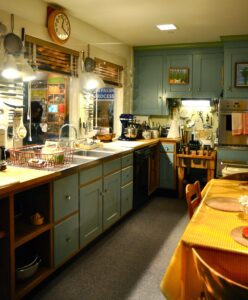
There is no single right way. Pay attention to what helps you feel open and creative, not what looks perfect on Instagram.
4. Use light as a partner
Light changes how we feel in our bodies, which changes how we think. Everyone has a “magic hour” when inspiration feels more available. For some, it is the first morning light creeping into the front room. For others, it is the late afternoon glow in the office or the quiet of twilight when the sky shifts from lavender to an inky blue.
Notice when the light supports your mood and your thinking. Whenever you can, schedule your more expansive work during those windows.
From Concept to Practice
If you want to experiment with the Cathedral Effect, try this simple personal practice in the coming week:
- Pick one problem or question that needs creative thought.
- Work on it in three different environments. For example, your usual desk, a clear table near a window, and a café or outdoor space with a wider view.
- Pay attention to how your thinking changes in each place. What happens to your ideas, your energy, and your sense of possibility?
Leaders can take this further and run a “meeting environment audit.” Alternate strategic meetings between different spaces for a month and notice how the quality of ideas and engagement shifts. Then plan one “cathedral meeting” on purpose and choose the most spacious, light filled location available. See what happens when the room quietly tells everyone at the table, “Think bigger.”
The Cathedral Effect reminds us that spaciousness is not only something we feel. It is something we can create. Our physical spaces shape our mental spaces.
You may not be able to rebuild your office, but you can clear your line of sight, step toward the light, or walk outside for a few minutes of sky. You can choose more cathedral moments, and inspiration just may follow.